Tuesday, 3 November 2015

CITROEN

DIRAVI

In the DIRAVI system invented by Citroën, the force steering the wheels comes from the car's high pressure hydraulic system and is always the same no matter what the road speed is. Turning the steering wheel moves the wheels simultaneously to a corresponding angle via a hydraulic cylinder. In order to give some artificial steering feel, there is a separate hydraulically operated system that tries to turn the steering wheel back to centre position. The amount of pressure applied is proportional to road speed, so that at low speeds the steering is very light, and at high speeds it is very difficult to move more than a small amount off centre. Citroën engineer Paul Magès invented the system as part of its effort to engineer a practical high horsepower, front wheel drive car.
As long as there is pressure in the car's hydraulic system, there is no mechanical connection between the steering wheel and the road wheels. This system was first introduced in the Citroën SM in 1970, and was known as 'VariPower' in the UK and 'SpeedFeel' in the U.S.
While DIRAVI is not the mechanical template for all modern power steering arrangements, it did innovate the now common benefit of speed sensitive steering. In the late 1960s, General Motors offered a variable-ratio power steering system as an option on Pontiac and other vehicles.


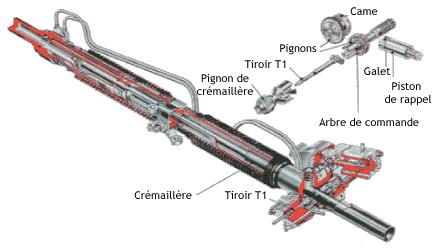
Citroen DIRAVI type closed-center arrangement.

The SM DIRAVI is based on the DS Dirass with a closed-center arrangement, speed powered steering wheel and forced return. The CX DIRAVI differ structurally with respect to the SM DIRAVI by another control command. Herein, the hydraulic arrangements with a different kind of differentiaalregelaar are grouped together next to the axis. XM DIRAVI equals the CX DIRAVI with the difference that the eccentric disk has no recess in the straight position. Furthermore, the straight-ahead position with a rotary knob to adjust under para vane. This is done because it DIRAVI wheelhouse is accessible from the ZPJ (4) V6 engine compartment.


Functioning

                                                                                           Neutral position  


1. Principle of control when cornering
A very small revolution of the driving shaft makes piston T1 slides, chamber B is then related either to incoming pressure or to outgoing pressure: chamber B develops hydraulic volume variations.
The size of the hydraulic section to chamber B and the onset of the pressure depends on how fast the driver turns his steering wheel.
The piston of the rack hydraulic command deals with two opposite forces of the same values:


                                         The balance is triggered by valve T1.

fig.1


Left turn - Fig. 2


The volume variation in chamber B (increase) pushes on S of the piston a dominating force pushing the rack to the left
This efficient control lets the driver a very small effort to give to the steering wheel. This gives a vehicle that is very easy to drive in a city and enhance very low speed manoeuvres


                                                               Fig.2
Because of the cam design, the effort increases with the cornering angle ; this allows the driver an even higher precision for path modifications.


2 - Principle of the self-centering steering gear on straight lines

The very little effort to apply to the steering wheel when cornering requires a perfect centralizing system to keep the car with an efficient stability.
To preserve this stability whatever the speed, the return effort to set back the steering wheel is applied on the cam by the roller increases with the speed through the centrifugal regulator.

This centralizing effort increase enhances the precision when rapid course changes.
The regulator speed connected to the front of the gearbox depends on the speed of the vehicle.


Neutral position 50 km/h - Fig. 3


The pressure given by the centrifugal regulator pushes the return piston and puts the system at its center position.


              Neutral position 200 km/h - Fig. 4


Because of the centrifugal force, the leads move apart, piston T2 moves and increases the pressure on the return piston increasing the effects of the centralizing system.


Feature

  • Fully hydraulic (no direct mechanical connection between the steering wheel shaft and the steering pinion during normal operation).
  • Power operated unlike conventional power assisted steering systems.
  • Rapid self centering to straight ahead position - whenever the engine is running the steering wheel will return to center, even when parked
  • Artificial feel inbuilt - centering force varies in proportion to vehicle speed and/or steering wheel deflection.
  • Power for the system from a regulated high pressure hydraulic pump which also operates the brakes and suspension system.
  • The steering is operated by a rack and pinion system which normally only works as a feedback loop.
  • The rack takes the form of a double acting hydraulic ram, but is capable of taking over full steering function in the event of a hydraulic failure. During normal operation the rack and pinion merely provides a position indication to the steering control valve through the pinion shaft. The rack and pinion do the actual steering only in the absence of system hydraulic pressure.
  • A hydraulic power safety prioritisation valve sets hydraulic fluid availability to each circuit in the Citroën system.
  • In a hydraulic system failure, order of loss is first steering, then suspension, then brakes.


Advantages

  • No steering kickback - blowouts, potholes, ruts, etc. cannot affect the steering wheel or the direction of the steered wheels which can only be moved by steering wheel input, since apparent feedback is entirely artificial and bears no relation to the actual forces on the front wheels from the vehicle's inertia and the roadway
  • Requires minimal physical exertion - In the SM the steering wheel can be turned lock-to-lock with one finger when the car is standing
  • Very fast (minor steering inputs equal large front wheel movements)
  • Can be set up permitting vehicle to travel in a straight line without driver input on a constant camber road in still conditions


Disadvantaged


  • No feedback to the driver - apparent feedback is entirely artificial and bears no relation to the actual forces on the front wheels from the vehicle's inertia and the roadway
  • Driver must survey visual cues to determine approach of road holding limit
  • Requires familiarization - novices find DIRAVI too fast and sensitive
  • Cannot allow both hands to leave steering wheel when navigating curves - because of rapid self centering


REFERENCE


Sunday, 1 November 2015

POWER STEERING


For decades, the steering wheel remained nothing more than a wooden circle, mounted inside the car and through which the driver controlled the directional movement of the vehicle. It had and it served no other purpose. As you might imagine, steering with early wheels was not an easy task, as the whole procedure was done mechanically: the driver pulled the steering wheel to the left or right. Of course, the wheels resisted the commands, and the friction with the surface below made steering a difficult task at times, especially when the car was stationary


Several attempts to introduce power steering to the automotive world were made. G.W. Fitts received a patent for a power steering gear all the way back in 1876, while a vacuum-based system was patented in 1904; in 1902, Frederick W. Lanchester patented a hydraulic power system in the UK. Yet, none of them made it into production.

It was in the 1920s when experiments with what was to become the precursor of power steering began. Francis W. Davis, an engineer with the Pierce Arrow Motor Car Company, trying to make steering for truck drivers a little easier, ended up inventing the first power steering system to be fitted into a car.

Coincidentally or not, it was the nautical industry which sparked the advent of power steering in cars, as it had done with the steering wheel itself. Davis based some of his early work on the power steering system used in ships, only that with hydraulics. He slowly worked his way around several problems he encountered and managed to fit his system into a Cadillac.


Between 1931 and 1943, Davis received patents for five different inventions which made up the power steering system. His invention was acknowledged by GM, who made a contract with Davis to fit it into future Cadillac models. The contract was eventually scrapped in 1934 due to the economic crisis.

In 1936 the Bendix Corporation took note of Davis' work and signed a deal with him to build and promote the product. By 1939, ten models using Davis' hydraulic power system had been built and only two sold. Again, coincidentally or not, GM bought two systems to fit them into experimental Buicks. And then the war broke out...

As it did in so many fields of human existence, the war pushed power steering development into high gear. The driving force behind it was the Military one, who wanted, obviously, easy controllable war machines. Bendix-Davis systems saw action for the first time in 1940, after being fitted into Chevrolet armored vehicles built for the British Army. By the end of the war, over 10,000 vehicles equipped with power steering were roaming the battlefields.

After the war, Chrysler began developing its own power steering, based on Davis' expired patents. The system was featured on the Chrysler Imperial and was named Hydraguide. Since competition is the driving force of the industry during peace time, GM made a deal with Davis for the system and by 1953, 1 million vehicles using it were built. The success was immense and instant: by 1956, one in four cars on the roads had power steering. By the next decade, 3.5 million power steering systems were sold.

Since Davis, several types of power steering systems have been developed. Depending on what is used to power the steering wheel, the systems can be hydraulic, as Davis', electro-hydraulic, electric and so on. Some manufacturers, like Citroen and AM General, patented their own technologies (DIRAVI and Servotronic, respectively).

Today, the ratio has turned against non-power-assisted vehicles. Yet, despite a new role for the steering wheel, that of making the driver's task easier, the steering wheel itself remained in design as simple as it got. The only added function was the introduction of the airbag in the 1970s.


Wednesday, 14 October 2015

INTRODUCTION


The steering system in an automobile is the system that allows the driver to modify according to his will the trajectory of his vehicle according to the circumstances.
The vehicle stability, comfort and security will also depend on the steering system used on the car. The steering system is a main issue. Careful design has to be provided for this element. A perfect steering system has to fully comply with the following elements:

·         Security,
·         Smoothness,
·         Precision,
·         Irreversibility,
·         Stability,
·         Compatibility with the suspensions.

To comply with all these requirements and to allow the driver to use without any difficulty a car with a such exceptional road handling and a car with a high performance engine, Citroën created a new steering system which has no equivalent in the world.
The steering system goal is to enhance the security at high speed, and to speed up the movements at low speed and also to increase the comfort in removing any reaction. This breakthrough in the automotive domain at least equivalent to the hydropneumatic suspension breakthrough.


STEERING SYSTEM


The steering system consists of a rack and pinion with a hydraulic variable rate power according to the vehicle speed, with centraliser device.

Ratio: 1 : 9,4.

·         Number of steering wheel revolutions (max left to max right): 2.
·         Steering wheel column in two parts using two double universal joints.
·         The steering wheel can be adjusted in both angle and depth.

Turning circle

·         between bands: 10,50 meter
·         between walls: 11,50 meter


Saturday, 10 October 2015

History of steering System


The steering wheel of a car is one of those instruments which we pretty much take for granted. We mean, who ever heard of a car with no steering wheel? When buying a new car for instance, we bring hell upon the head of the sales person, asking all kinds of more or less ridiculous questions about the fabric on the seats, the number of bolts holding the wheels in place or the composition of the paint. In very rare cases, we think to ask about the steering wheel.

Some of us even think the steering wheel magically came to be at the same time the car did. That it was somehow already in the mind of the inventor as the perfect tool to make the new contraption work. That's not entirely true. The steering wheel did not came to be at the same time with the car, but was adopted later, as it became obvious its shape is perfect for the task.

You must take into account that at the turn of the 19th century, when the idea of the automobile germinated in the minds of the time's inventors, there was really a single man-made machine the man himself controlled: boats.

There was no way to steer a train, as its tracks guided it from point A to point B without human input. Turning a carriage only meant pulling the harness left or right, depending on your intentions, so there was no need for an additional mechanical device to be created.

All of the above meant that the car's inventors had really one source for inspiration when trying to figure out how to steer a car: boats. Boats used human activated rudders, controlled by means of tillers, to turn, so the idea appealed to the car's creators.

By 1894 however, the use of a tiller to steer a car became more and more ineffective. Taking inspiration from the same nautical industry, car builders began replacing the tillers with ship-inspired helms. Simpler and smaller than their nautical counterparts, the steering wheels in the car made their mark during the Paris-Rouen race, when the Panhard model driven by Alfred Vacheron was first recorded using a steering wheel to turn.

The ease of operation shown in the 1894 race meant that by 1898, all Panhard et Levassor cars came equipped as standard with steering wheels. The principle quickly caught on and similar systems sparked across the world. In Britain, Charles Stewart Rolls bought a Panhard from France and implemented the steering wheel into his designs. By 1899, the steering wheel fever expanded to the US, where Packard introduced the steering wheel on one of its models. By the time the Model T arrived, the steering wheel was an essential part of the car.

After that moment, the steering wheel stuck with the car, with its most common shape, that of a circle, unchanged for more than a century now. What did (and still does) change however is the purpose the steering wheel serves. As humanity crawls its way through the 21th century, the steering wheel is quickly leaving behind its established role of "helm of the car" and becomes more and more of a command hub for the entire vehicle. But let's take it one step at the time.